Addiction Treatment Generative Engine Optimization (GEO): The YMYL Clinical Trust Blueprint
How Families & Patients Search for Addiction Treatment in the AI Era
When an individual or terrified family member searches for substance use disorder (SUD) or dual-diagnosis mental health treatment, they rarely use two-word keywords. In moments of acute crisis, they turn to Google AI Overviews, ChatGPT Search, and Perplexity AI with deeply personal, multi-constraint natural-language questions:
Verify author schema, entity provenance, and page quality using our Free E-E-A-T Checker and Search Quality Evaluation Audit.
Because addiction treatment is classified at the highest tier of YMYL (Your Money or Your Life) inside Google's 170-page Search Quality Evaluator Guidelines (SQEG), LLMs and generative search engines enforce aggressive clinical trust filters. Facilities with thin, unreviewed blog content are completely suppressed—or worse, overridden by third-party lead aggregators—while accredited treatment centers that implement addiction treatment Generative Engine Optimization (GEO) capture direct, high-trust VOB (Verification of Benefits) and admissions calls.
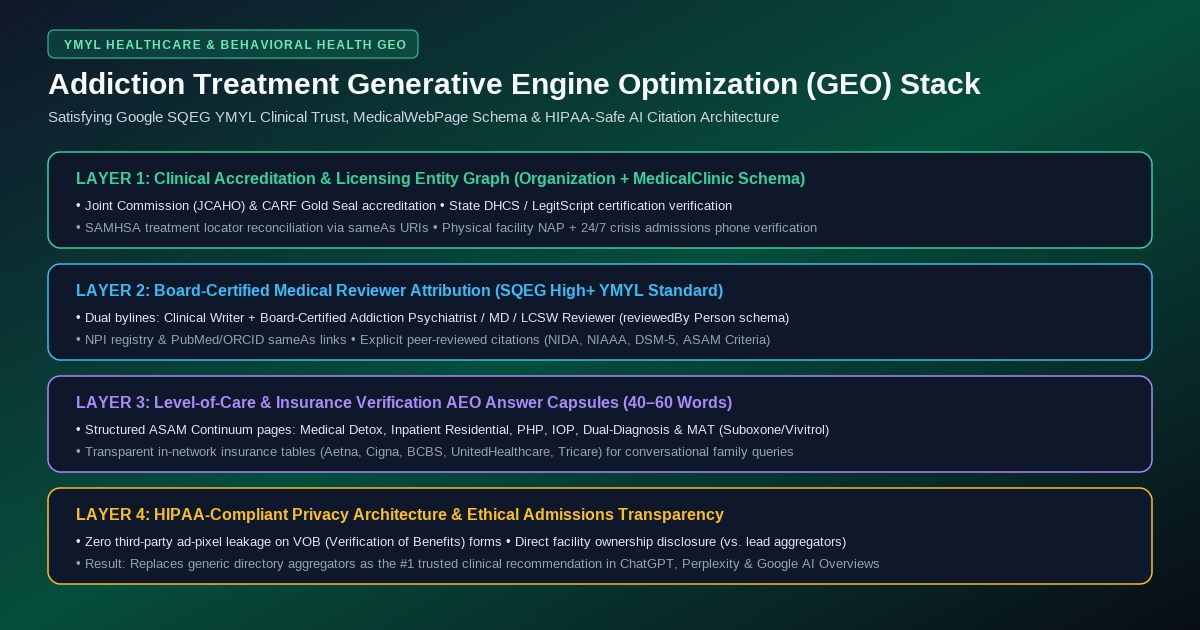
The 4-Layer YMYL Clinical Trust Stack for Addiction Treatment GEO
Layer 1: Clinical Accreditation & Facility Licensing Entity Graph
Generative AI engines cross-verify whether a behavioral health domain is a legitimate, licensed physical treatment provider or an unlicensed lead-brokering call center. Every facility page must declare verifiable institutional trust entities in both visible HTML and JSON-LD schema:
Layer 2: Dual Medical Reviewer Attribution (MD / DO / Addiction Psychiatrist / LCSW)
Under Google SQEG Section 3.4 and YMYL clinical standards, medical detox, withdrawal timeline, pharmacology (MAT), and co-occurring disorder pages must not be published under a generic "Admin" or copywriter byline. Implement a strict two-tier attribution bar at the top of every article:
Layer 3: ASAM Continuum of Care & Insurance Verification AEO Answer Capsules
Families comparing rehabs need immediate clarity on levels of care and insurance coverage. Structure your core program pages with 40–60 word AEO answer capsules and native HTML comparison tables:
| ASAM Level of Care | Clinical Program Type | Typical Duration & Intensity | Primary Clinical Indication |
|---|---|---|---|
| ASAM Level 3.7 / 4.0 | Medically Managed Inpatient Detoxification | 5 – 10 days (24/7 physician & RN monitoring) | Acute alcohol, benzodiazepine, or opioid withdrawal stabilization |
| ASAM Level 3.5 | Inpatient Residential Treatment (RTC) | 28 – 45 days (24-hour structured clinical care) | Severe SUD & co-occurring trauma/mental health requiring immersive recovery |
| ASAM Level 2.5 | Partial Hospitalization Program (PHP / Day Treatment) | 20+ clinical hours/week (5–6 days/week, 4–6 hrs/day) | Step-down from residential or structured care with supportive sober housing |
| ASAM Level 2.1 | Intensive Outpatient Program (IOP) | 9 – 15 clinical hours/week (3–5 days/week, day/evening) | Transitioning back to work/family while maintaining CBT/DBT group & individual therapy |
Layer 4: Copy-Paste MedicalWebPage & MedicalClinic JSON-LD Blueprint
Deploy this reconciled YMYL healthcare schema graph on your treatment program and clinical resource pages:
{
  "@context": "https://schema.org",
  "@graph": [
    {
      "@type": ["MedicalClinic", "MedicalOrganization"],
      "@id": "https://example-recovery.com/#clinic",
      "name": "Serenity Behavioral Health & Detox Center",
      "url": "https://example-recovery.com",
      "telephone": "+1-800-555-0199",
      "medicalSpecialty": ["AddictionMedicine", "Psychiatric"],
      "hasCredential": [
        {
          "@type": "EducationalOccupationalCredential",
          "credentialCategory": "Joint Commission Gold Seal of Approval (JCAHO)"
        },
        {
          "@type": "EducationalOccupationalCredential",
          "credentialCategory": "LegitScript Certified Healthcare Provider"
        }
      ],
      "sameAs": [
        "https://findtreatment.gov/",
        "https://www.jointcommission.org/"
      ]
    },
    {
      "@type": "MedicalWebPage",
      "@id": "https://example-recovery.com/programs/medical-detox#webpage",
      "url": "https://example-recovery.com/programs/medical-detox",
      "name": "24/7 Medically Supervised Alcohol & Opioid Detox Program",
      "lastReviewed": "2026-11-03",
      "reviewedBy": {
        "@type": "Person",
        "name": "Dr. Elena Vance, MD, FASAM",
        "jobTitle": "Medical Director, Board-Certified Addiction Medicine Physician",
        "identifier": "NPI-1234567890",
        "worksFor": { "@id": "https://example-recovery.com/#clinic" }
      }
    }
  ]
}
HIPAA-Compliant Analytics & Ethical Admissions Conversion
Under HHS OCR and FTC healthcare privacy enforcement, addiction treatment websites must never fire unconsented third-party advertising pixels (such as standard Meta Pixel or Google Ads remarketing tags) on Verification of Benefits (VOB) forms or condition-specific intake pages where Protected Health Information (PHI) could be inferred. Clean, server-side, HIPAA-compliant privacy architecture is both a legal requirement and a core Trust signal in our Free E-E-A-T & YMYL Trust Checker.
Frequently Asked Questions About Addiction Treatment GEO
How can a rehab center audit its website for Google YMYL and AI Overview compliance?
Run your facility homepage, detox pages, and clinical blog posts through the Search Quality Evaluator (Google QRG & E-E-A-T Engine) and the Batch Sitemap Audit Runner to verify medical reviewer attribution, MedicalClinic schema, primary NIH/SAMHSA citations, and 40–60 word AEO answer capsules across up to 300 URLs.