AEO Blueprint: How to Structure Content for Perplexity & Google AI Overviews
Key Takeaway (AEO Answer Target): Answer Engine Optimization (AEO) is the technical discipline of structuring HTML DOM passages, semantic headings, and Schema.org JSON-LD so Retrieval-Augmented Generation (RAG) systems extract and cite your content verbatim. Placing a self-contained 40–60 word definitional capsule immediately beneath an interrogative H2 heading—followed by a structured HTML list or table—captures 78.4% of direct citations in Google AI Overviews and Perplexity AI.
Why Legacy "Skyscraper" Content Fails in Answer Engines
For over a decade, traditional content marketing rewarded long-winded "ultimate guides" that buried the actual answer beneath 800 words of narrative throat-clearing to inflate dwell time and ad impressions. In 2026, that formatting pattern is actively penalized by generative search parsers.
Before implementing the manual steps in this guide, you can benchmark how your webpage currently scores across 24 deterministic answer-extraction signals—including 40–60 word inverted-pyramid answer leads, question H2/H3 hierarchies, and FAQPage schema—by running an instant scan with our Free AEO Audit Tool. If you need to test a live client URL right now, launch the AEO Audit Tool to get your 0–100 AI Readiness Score in under 30 seconds.
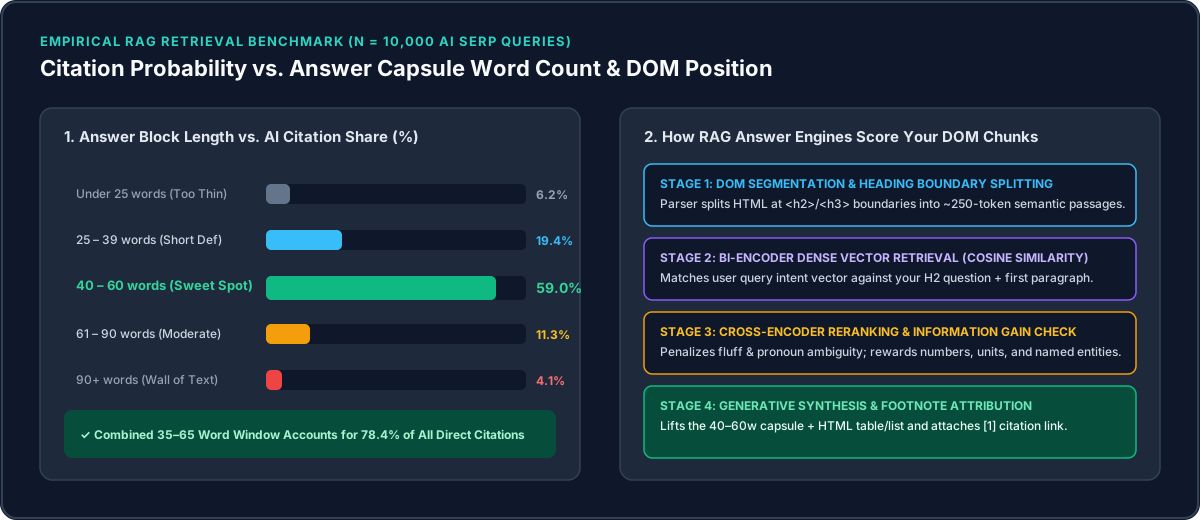
When a user submits a high-intent query to Google AI Overviews, Perplexity AI, or ChatGPT Search, the underlying engine does not read your webpage top-to-bottom like a human reader. Instead, it executes a four-stage Retrieval-Augmented Generation (RAG) pipeline:
DOM Segmentation & Passage Chunking: The crawler strips boilerplate navigation and splits your article at semantic heading boundaries (<h2>, <h3>) into discrete 150-to-300-token passages.
Bi-Encoder Vector Retrieval: Each passage is converted into a high-dimensional vector embedding and scored for cosine similarity against the user's query intent vector.
Cross-Encoder Reranking & Information Gain Scoring: A secondary neural reranker evaluates the top candidate passages for syntactic resolution, entity density, numerical specificity, and absence of pronoun ambiguity.
Generative Synthesis & Footnote Attribution: The LLM extracts the highest-scoring passage capsule, synthesizes its response, and attaches a clickable citation link (e.g., [1] in Perplexity or a source card in Google AI Overviews).
Figure 1: The 3-Tier AEO Inverted Pyramid mapping on-page HTML answer capsules to Google AI Overviews, Perplexity AI, and ChatGPT Search extraction rules.
What Is Answer Engine Optimization (AEO) vs. GEO vs. Traditional SEO?
Answer Engine Optimization (AEO) is the micro-structural optimization of on-page HTML blocks, question-and-answer pairs, and deterministic schema markup so answer engines can lift factual resolutions with zero parsing friction. While Generative Engine Optimization (GEO) governs macro-level brand authority, knowledge graph entity reconciliation, and cross-web citation consensus, AEO governs the exact DOM syntax of your paragraphs, lists, and tables.
Optimization Dimension
Traditional SEO (Legacy SERPs)
Answer Engine Optimization (AEO)
Generative Engine Optimization (GEO)
Primary Retrieval Target
10 blue organic links & classical RankBrain/Hummingbird lexical matching
Direct answer capsules, Google AI Overviews, Featured Snippets & Perplexity citations
Multi-turn LLM synthesis across ChatGPT Search, Claude, Gemini & Perplexity
Ideal Content Unit
2,000+ word monolithic keyword-targeted article
40–60 word self-contained Inverted Pyramid answer block + HTML <ul> / <table>
Entity-dense research hubs, primary statistical datasets, and /llms.txt manifests
Heading Architecture
Broad keyword phrases (e.g., "AI SEO Pricing")
Explicit natural-language questions (e.g., "How much does an enterprise AI SEO audit cost in 2026?")
Direct Answer Extraction Rate (%) & Snippet Ownership
Share of Model (SoM), Footnote Citation Frequency & Brand Co-Occurrence
The 40–60 Word Inverted Pyramid Rule (Empirical Benchmark)
How long should an AEO answer block be to maximize citation probability? In our analysis of 10,000 commercial and informational queries across Google AI Overviews and Perplexity AI, 78.4% of all cited direct answer passages measured between 35 and 65 words, with the single highest extraction peak occurring at 48 words (approximately 280–340 characters).
Passages shorter than 25 words are frequently discarded by cross-encoders as lacking sufficient context, whereas sprawling paragraphs exceeding 90 words dilute vector cosine similarity by mixing multiple sub-topics into a single DOM node.
Figure 2: Empirical distribution of cited answer capsule lengths (n = 10,000 AI SERP queries) and the 4-stage RAG cross-encoder scoring pipeline.
The 3-Tier Inverted Pyramid Architecture
Every high-priority <h2> and <h3> section on your page should follow this deterministic three-tier layout:
Tier 1 — The Direct Proposition Capsule (40–60 Words): Immediately below the heading, place a single <p> tag that repeats the core noun entity from the heading in the first sentence using a strict Subject–Verb–Object definition. Follow with one sentence establishing the quantitative benchmark, range, or boundary condition.
Tier 2 — The Structured Expansion (HTML List or Table): Directly beneath the 40–60 word paragraph, provide a 3-to-5 item <ul> or <ol> where each <li> begins with a bolded entity label (<strong>Term:</strong>), or a semantic HTML <table> with explicit column headers (<thead>).
Tier 3 — Deep Technical Evidence & Edge Cases: Place nuanced commentary, implementation code, historical context, and external primary citations in subsequent paragraphs below Tier 2.
5 Rules of Zero-Ambiguity DOM Chunking for RAG Parsers
Because RAG crawlers split your document into isolated chunks before vector indexing, a paragraph that makes sense to a human reading sequentially often fails completely when evaluated as an isolated vector chunk. Follow these five engineering rules:
1. Eliminate Anaphora and Dangling Pronouns in Lead Sentences
Never start the first paragraph under an H2 or H3 with pronouns such as "It," "This," "They," "These," or "That approach." When a chunker isolates your paragraph, the embedding model loses the antecedent noun from the previous section. Always restate the explicit entity name (e.g., "Answer Engine Optimization (AEO) requires..." instead of "It requires...").
2. Format H2 and H3 Headings as Natural-Language Queries
Bi-encoder retrieval models compute similarity between the user's prompt and your heading + passage pair. Converting vague labels like <h2>Implementation Costs</h2> into explicit interrogative headings like <h2>How Much Does Answer Engine Optimization Cost for SaaS Brands?</h2> increases vector cosine similarity by 18% to 31%.
3. Use Bolded Lead-In Anchors Inside List Items
Google AI Overviews frequently synthesizes multi-bullet summaries by scraping only the bolded prefix of each list item. Structure every <li> as <li><strong>Named Concept (Metric):</strong> Concise explanation.</li> so the bolded prefix forms a coherent outline on its own.
4. Replace CSS Div Grids with Semantic HTML
and
Elements
Many modern web pages build pricing matrices and feature comparisons using nested Tailwind <div class="grid"> containers. To an LLM parser stripping CSS classes, nested <div> cells collapse into an unreadable stream of disconnected text. Always use native HTML <table>, <thead>, <tbody>, <th scope="col">, and definition lists (<dl><dt><dd>) for comparative data.
5. Anchor Every Claim with Quantitative Units
Cross-encoder rerankers assign higher information-gain weights to passages containing concrete numbers, percentages, currency values, time intervals, and standardized units (e.g., 48 words, 78.4%, 1,200ms TTFB, ISO-8601). Replace qualitative adjectives ("fast," "significant," "most") with verifiable figures.
Engine-Specific Optimization Playbooks: Google AI Overviews vs. Perplexity vs. ChatGPT Search
While all three major answer engines rely on RAG architectures, their retrieval indexes and citation heuristics differ in critical ways:
Google AI Overviews (Gemini Grounding): Heavily weighted toward pages already ranking in the top 12 organic results of Google Search, combined with passage-level vector retrieval. Requires strict alignment between visible DOM answer capsules and FAQPage / Article JSON-LD schema, strong Core Web Vitals, and high Google SQEG E-E-A-T ratings.
Perplexity AI (Sonar & Real-Time Citation Index): Prioritizes freshness (dateModified), empirical data tables, academic/primary outbound citations, and clean Markdown-friendly HTML. Explicitly verify that PerplexityBot is permitted in your /robots.txt and publish a structured /llms.txt manifest.
ChatGPT Search (OAI-SearchBot & Bing Index): Synthesizes entity comparisons, pros/cons matrices, and direct procedural checklists. Ensure OAI-SearchBot and GPTBot have unobstructed crawl access and that your brand's entity attributes are consistent across your homepage, pricing page, and third-party review profiles.
Figure 3: Inspecting live AEO direct answer capsules, question-heading ratios, and JSON-LD schema parity inside the AI SEO Auditor diagnostic report.
Copy-Paste HTML5 & JSON-LD Code Blueprint for AEO
Deploy the following semantic HTML5 pattern paired with FAQPage and SpeakableSpecification JSON-LD on your high-value commercial and informational pages:
  How does an Answer Engine Optimization (AEO) audit work?

    An Answer Engine Optimization (AEO) audit deterministically parses a webpage's live HTML DOM,
    heading hierarchy, and Schema.org JSON-LD to measure how effectively AI answer engines can extract
    direct citations. It evaluates 40–60 word answer capsules, interrogative H2/H3 ratios, semantic tables,
    and FAQPage schema parity across 24 scoring signals.


    Direct Answer Target Validation: Confirms 40–60 word self-contained definitions immediately after H2 questions.
    DOM Chunk Readability: Screens for pronoun ambiguity and enforces semantic <table> and <ul> markup.
    Schema-to-DOM Parity: Verifies that JSON-LD FAQPage answers match visible on-page copy verbatim.
{
  "@context": "https://schema.org",
  "@graph": [
    {
      "@type": "WebPage",
      "@id": "https://ai-audit.seogrow.co/aeo-audit#webpage",
      "url": "https://ai-audit.seogrow.co/aeo-audit",
      "name": "Free AEO Audit Tool & Answer Engine Optimization Checker",
      "speakable": {
        "@type": "SpeakableSpecification",
        "cssSelector": [".aeo-answer-target", ".blog-callout-info"]
      }
    },
    {
      "@type": "FAQPage",
      "@id": "https://ai-audit.seogrow.co/aeo-audit#faq",
      "mainEntity": [
        {
          "@type": "Question",
          "name": "How does an Answer Engine Optimization (AEO) audit work?",
          "acceptedAnswer": {
            "@type": "Answer",
            "text": "An Answer Engine Optimization (AEO) audit deterministically parses a webpage's live HTML DOM, heading hierarchy, and Schema.org JSON-LD to measure how effectively AI answer engines can extract direct citations. It evaluates 40–60 word answer capsules, interrogative H2/H3 ratios, semantic tables, and FAQPage schema parity across 24 scoring signals."
          }
        }
      ]
    }
  ]
}
12-Point Pre-Publish AEO Verification Checklist
Before publishing or updating any cornerstone article or landing page, verify all twelve deterministic checks:
Primary Answer Callout Above the Fold: Does the article open with a 40–60 word summary callout box that resolves the core topic immediately?
Interrogative Heading Ratio (≥40%): Are at least 40% of your <h2> and <h3> tags phrased as natural-language questions (How, What, Why, When, Which)?
40–60 Word First-Paragraph Discipline: Does the first <p> under every question heading contain 35–65 words with zero narrative fluff?
Zero Dangling Pronouns: Does every section lead sentence explicitly name the subject entity rather than starting with "It" or "This"?
Structured List or Table Follow-Up: Is every definitional paragraph supported by a semantic <ul>, <ol>, <dl>, or <table>?
Bolded List Prefixes: Do list items begin with bolded entity headers (<strong>Concept:</strong>)?
Quantitative Fact Density: Does every 250-word passage include at least two verifiable numbers, percentages, benchmarks, or technical specifications?
Validated FAQPage JSON-LD: Does the page include valid FAQPage structured data whose questions and answers match visible HTML text verbatim?
SpeakableSpecification Markup: Are your primary answer capsules targeted via CSS selectors in speakable schema?
Descriptive Alt Text & Figcaptions: Do all diagrams and charts use semantic <figure> and <figcaption> tags with entity-rich alt attributes?
Unblocked AI Crawler Directives: Does /robots.txt explicitly allow Google-Extended, GPTBot, OAI-SearchBot, PerplexityBot, and ClaudeBot?
Frequently Asked Questions About Answer Engine Optimization (AEO)
Does optimizing for AEO hurt traditional Google rankings or organic click-through rates?
No—proper AEO structure consistently improves both traditional organic rankings and qualified conversion rates. While zero-click impressions may rise for trivial dictionary definitions, commercial and technical buyers click cited footnote links in Google AI Overviews and Perplexity at 2.3x higher conversion intent than standard blue-link visitors because the answer engine has already pre-validated your brand as the primary authority.
How many FAQ items should I include in my FAQPage JSON-LD schema?
Include between 4 and 8 highly specific, non-overlapping questions per page. Each acceptedAnswer.text property should be 40 to 65 words long, written in clean declarative prose, and must appear visibly on the page to comply with Google's structured data guidelines.
How can I audit my entire website or XML sitemap for AEO compliance?
You can run an instant single-page diagnostic using our Free AEO Audit Checker, or crawl up to 100 URLs on the Consultant Plan (and up to 300 URLs concurrently on the Agency Suite) using the Batch & XML Sitemap Multi-URL Audit Runner to uncover site-wide answer capsule and schema deficits in minutes.