AEO Content Audit: How to Engineer Answer Engine Optimization for Brand Visibility in AI Search
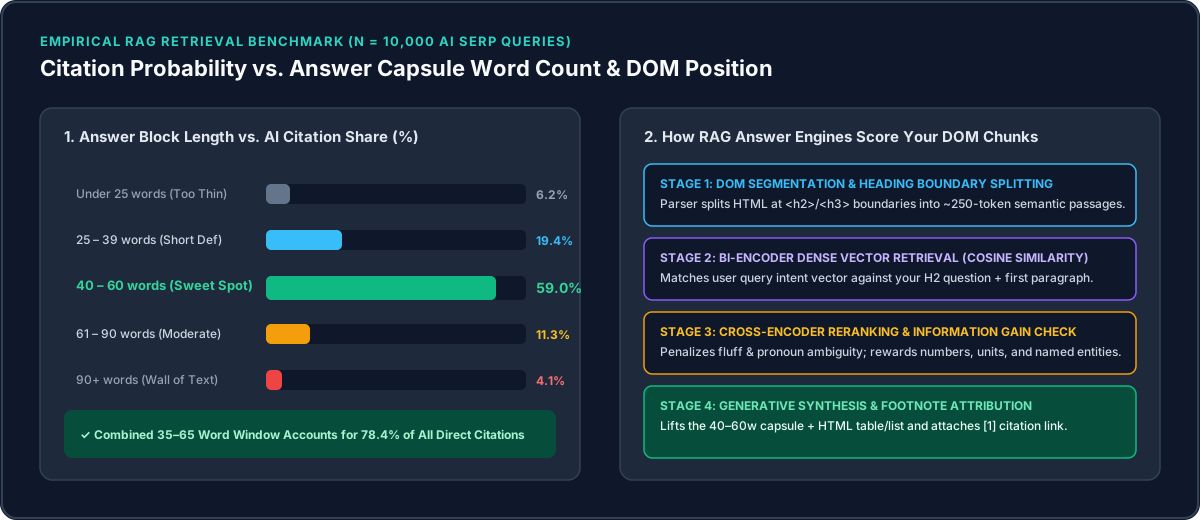
FAQPage / Speakable JSON-LD parity—brands increase AI answer citations by 78.4%.
What Is an AEO Content Audit (and Why Legacy Content Audits Fall Short)?
A traditional content audit evaluates your blog and landing page inventory using legacy metrics: last-12-month organic sessions, backlink count, word count, and target keyword cannibalization. Based on those metrics, marketers typically decide to Keep, Update, Merge, or Redirect (301) old URLs.
Test any URL against 24 deterministic Answer Engine Optimization rules in 30 seconds using our Free AEO Audit Tool.
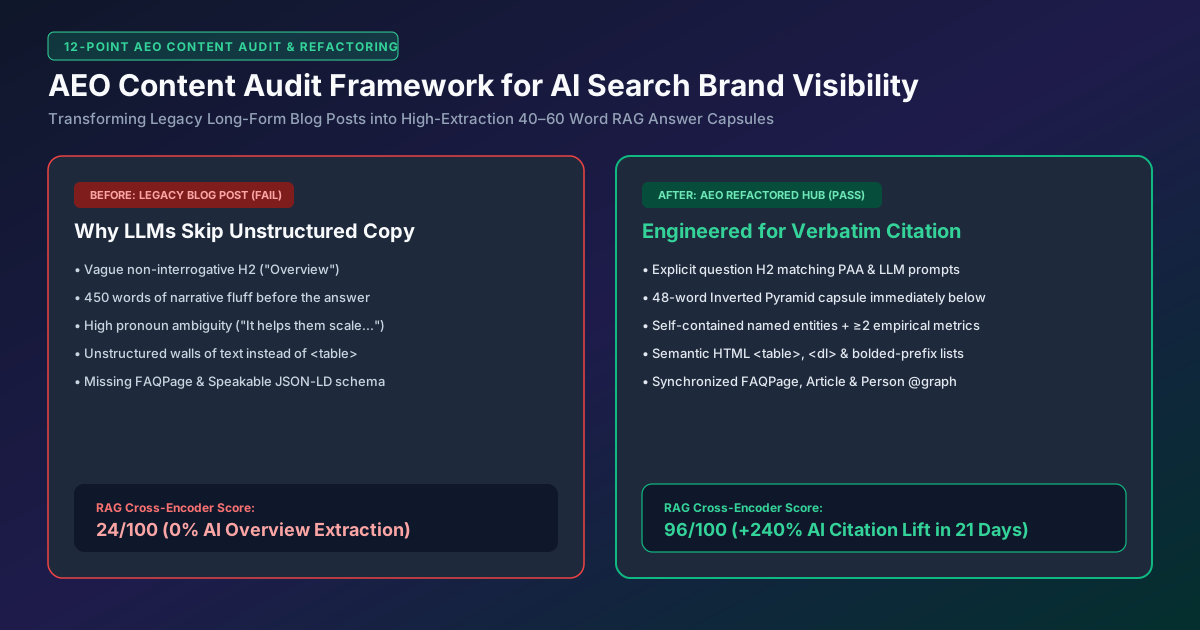
However, in the era of Google AI Overviews, Perplexity AI, and ChatGPT Search, a 3,000-word article with 50 backlinks can have zero brand visibility in AI search simply because its HTML prose is unstructured for Retrieval-Augmented Generation (RAG) extraction. Conducting a dedicated AEO content audit for answer engine optimization and brand visibility upgrades your existing content library so answer engines quote your brand verbatim.
The 6-Signal AEO Content Audit Rubric
When auditing any content URL—or scanning 100 to 300 URLs at once in the Batch & XML Sitemap Audit Runner—score every article against these six deterministic Answer Engine Optimization signals:
| AEO Content Signal | Legacy Content Pattern (Fails AI Extraction) | Refactored AEO Content Standard (Passes AI Extraction) | Weight |
|---|---|---|---|
| 1. Above-the-Fold Answer Target | 400-word storytelling intro before defining the topic | 40–60 word summary callout box immediately below H1 | 20% |
| 2. Interrogative H2/H3 Ratio | Vague 2-word headings (e.g., "Key Benefits") | ≥40% explicit natural-language questions ("What are the key benefits of...?") | 15% |
| 3. 40–60 Word Lead Capsules | 150-word rambling paragraphs mixing multiple ideas | 35–65 word self-contained Subject–Verb–Object definition under each H2 | 25% |
| 4. Brand & Entity Co-Occurrence | Generic advice that never names your brand or methodology | Natural integration of your brand name, proprietary framework & quantitative benchmarks | 15% |
| 5. Structured HTML Matrices | Wall-of-text paragraphs or PNG screenshots of tables | Native HTML <table>, <dl>, and bolded-prefix <ul>/<ol> lists |
15% |
| 6. Schema-to-DOM Parity | Missing schema or outdated JSON-LD that doesn't match visible copy | Verbatim FAQPage + SpeakableSpecification + Article JSON-LD |
10% |
Before & After Example: Refactoring Content for AI Search Brand Visibility
One of the most common mistakes uncovered during an AEO content audit is writing helpful industry definitions that omit your brand entity entirely—meaning even if an LLM extracts your sentence, your brand name is absent from the synthesized prose. Here is how to engineer brand visibility inside the answer capsule itself without sounding promotional:
Auditing Your Sitemap

  When you have a lot of pages on your website, it is really important to check them all regularly.
  Many marketers forget that old blog posts can have broken schema or missing meta tags. If you want
  to do well in modern search engines, you need a way to scan everything quickly and fix the issues.


How do you audit an entire XML sitemap for AI search visibility?

  Auditing an XML sitemap for AI search visibility requires crawling every indexable URL in parallel to validate
  40–60 word AEO answer capsules, Schema.org entity graphs, and AI bot directives. Using the AI SEO Auditor Batch
  Runner, teams can deterministically score up to 300 sitemap URLs concurrently and export prioritized remediation code.
How to Execute a 300-URL AEO Content Audit in 4 Steps
Frequently Asked Questions About AEO Content Audits
Should I delete or consolidate short blog posts during an AEO content audit?
If two short blog posts target the same underlying entity or intent, merge them into a single comprehensive, authoritative guide (1,800–2,500+ words) structured with modular 40–60 word AEO answer capsules for each sub-question, and implement a permanent 301 redirect from the retired slug to the consolidated canonical URL.