AEO vs. SEO in 2026: Key Differences, Ranking Signals & How to Combine Both
What Is the Difference Between AEO and SEO?
Search Engine Optimization (SEO) is the foundational discipline of making web pages crawlable, indexable, and authoritative so they rank high on traditional search engine results pages (SERPs) and drive organic click-through traffic. Answer Engine Optimization (AEO) is the specialized evolution of search engineering that formats on-page passages, question headings, and Schema.org structured data so AI answer engines extract, synthesize, and cite your content directly inside conversational responses.
Before implementing the manual steps in this guide, you can benchmark how your webpage currently scores across 24 deterministic answer-extraction signals—including 40–60 word inverted-pyramid answer leads, question H2/H3 hierarchies, and FAQPage schema—by running an instant scan with our Free AEO Audit Tool. If you need to test a live client URL right now, launch the AEO Audit Tool to get your 0–100 AI Readiness Score in under 30 seconds.
Rather than viewing AEO vs. SEO as an either/or choice, world-class search strategists implement AEO SEO as a two-layer stack: SEO earns your domain indexation and top-12 organic retrieval eligibility, while AEO ensures that the LLM cross-encoder selects your passage as the definitive cited answer.
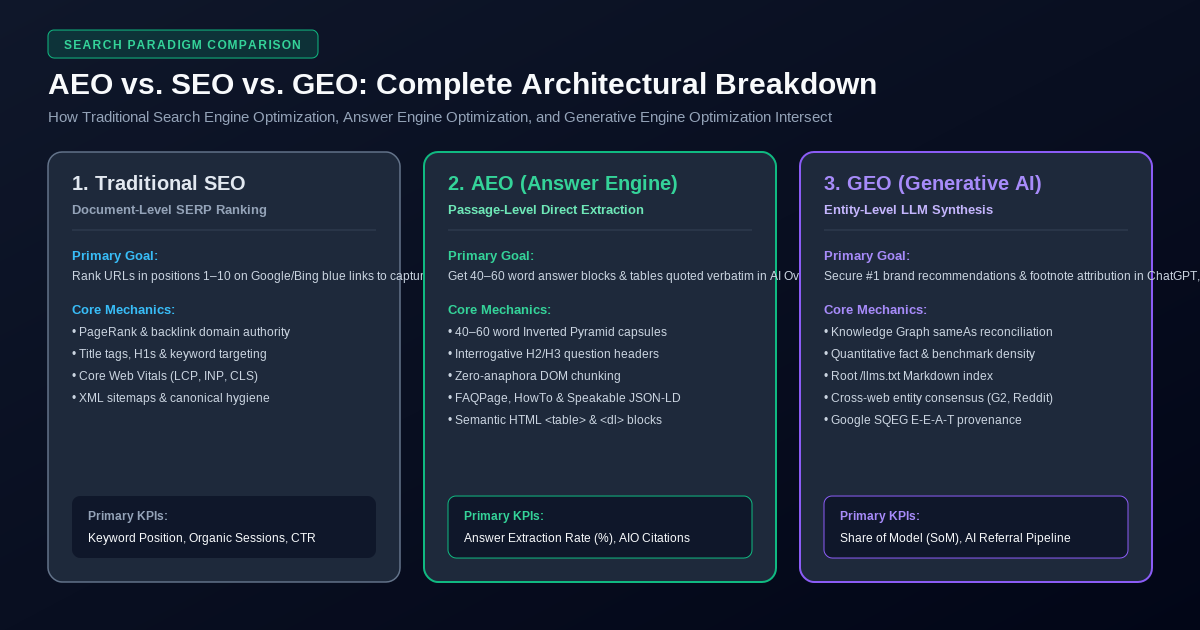
Master Comparison Table: AEO vs. SEO Across 8 Technical Dimensions
| Dimension | Traditional SEO | Answer Engine Optimization (AEO) | How to Unify Both (AEO SEO) |
|---|---|---|---|
| 1. Primary Target Surface | Google & Bing 10 blue organic links | Google AI Overviews, Perplexity AI, ChatGPT Search, Siri, Alexa & Featured Snippets | Target commercial keywords that trigger both AI Overviews and organic listings |
| 2. Granularity of Indexing | Document-level URL indexing | Passage-level DOM chunking (150–300 token vector blocks) | Build comprehensive long-form hubs divided into modular 40–60 word answer blocks |
| 3. Heading Syntax | Keyword-rich topic labels (e.g., "AEO SEO Guide") | Explicit interrogative questions (e.g., "What is the difference between AEO and SEO?") | Include the primary keyword inside natural-language H2/H3 question headings |
| 4. Lead Paragraph Style | Narrative hook or problem statement | 40–60 word Inverted Pyramid definition with zero pronoun ambiguity | Open every H2 with a 48-word direct definition, followed by deeper narrative context |
| 5. Data Formatting | Paragraphs, images & styled CSS cards | Native HTML <table>, <dl>, and bolded-prefix <ul>/<ol> lists |
Include at least one semantic HTML comparison table per article |
| 6. Schema.org Priority | WebPage, Article, BreadcrumbList |
FAQPage, QAPage, HowTo, SpeakableSpecification |
Combine all nodes inside a single connected JSON-LD @graph |
| 7. Crawler Access | Googlebot and Bingbot |
OAI-SearchBot, PerplexityBot, ClaudeBot, Google-Extended + /llms.txt |
Allow both traditional and AI search bots in /robots.txt |
| 8. Primary Success Metric | Organic sessions, keyword rank (1–10), CTR | Direct Answer Extraction Rate, Footnote Citation Share & Assisted Conversions | Track both organic clicks and multi-engine AI citation probability |
Why Traditional SEO Alone Fails in Zero-Click AI Overviews
In 2026, Google AI Overviews appear on over 60% of informational queries and more than 35% of commercial comparison queries. When an AI Overview expands at the top of the viewport, it pushes the #1 traditional organic blue link down by 750 to 1,100 pixels (below the fold on both desktop and mobile).
Pages optimized strictly for legacy SEO suffer a 20% to 40% CTR drop when an AI Overview appears—unless that page is also engineered for AEO, which allows it to capture the prominent cited source card inside the AI Overview itself.
The 5-Step Hybrid "AEO SEO" Implementation Blueprint
- Step 1 — Secure Top-12 Organic Eligibility (SEO Foundation): Maintain sub-2.5s LCP, clean canonical tags, strong internal topical cluster linking, and E-E-A-T authority so Google and Bing index your URL in the top candidate pool.
- Step 2 — Convert H2s into High-Intent Buyer Questions (AEO Layer): Map People Also Ask (PAA) and conversational LLM prompts directly to your
<h2>and<h3>tags. - Step 3 — Inject 40–60 Word Inverted Pyramid Answer Capsules: Place a concise, fact-dense 40–60 word answer immediately below every question heading.
- Step 4 — Pair Visible FAQs with
FAQPage&SpeakableJSON-LD: Use our Free AEO Audit Tool to verify 100% parity between your visible HTML answer blocks and your JSON-LD schema. - Step 5 — Benchmark & Monitor Across Both Engines: Test your hybrid pages in the AI SEO Auditor and Multi-Engine AI SERP Simulator.
Frequently Asked Questions About AEO vs. SEO
Will AEO replace SEO completely?
No. AEO does not replace SEO; it extends SEO into the generative retrieval layer. Because AI answer engines like Google AI Overviews and ChatGPT Search rely on underlying web search indexes (Google and Bing) to retrieve candidate documents before synthesizing answers, strong technical SEO remains the mandatory prerequisite for AEO success.