AI & LLM SEO Audits: How to Audit Your Website for ChatGPT, Claude, Gemini & Perplexity
sameAs graphs, and empirical fact density.
Why Traditional SEO Audits Fail to Diagnose LLM Invisibility
Traditional technical SEO crawlers (such as legacy Screaming Frog or Sitebulb configurations) were engineered for a single paradigm: helping Googlebot index HTML documents and pass PageRank through internal anchor links. They check whether your title tag is under 60 characters, whether your images have alt text, and whether your canonical tags resolve properly.
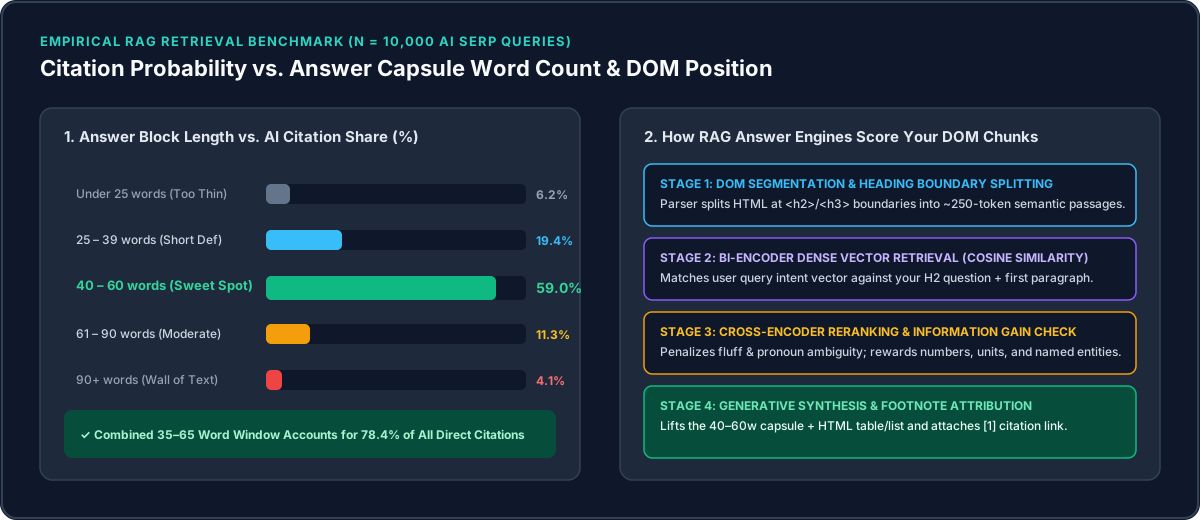
However, when an enterprise buyer asks ChatGPT Search, Claude 3.7+, Google Gemini, or Perplexity Sonar to compare vendors or solve a technical problem, the LLM does not rank whole webpages by backlink volume. Instead, it executes a real-time Retrieval-Augmented Generation (RAG) pipeline that parses isolated 200-token DOM chunks. Conducting dedicated AI LLM SEO audits is the only way to uncover why your pages are being dropped during vector retrieval and cross-encoder reranking.
The 5 Technical Pillars of an Enterprise AI & LLM SEO Audit
A production-grade AI LLM SEO audit inspects five deterministic layers across your domain:
Pillar 1: AI User-Agent Crawlability & Edge WAF Hygiene
Before an LLM can cite your content, its retrieval fetcher must access your raw HTML without encountering HTTP 403 Forbidden blocks, JavaScript-only rendering walls, or Captcha challenges. Your audit must explicitly test five primary AI user-agents:
- OpenAI Search & Training Bots:
OAI-SearchBot(powers live ChatGPT Search citations) andGPTBot(powers foundational model weights). - Perplexity AI Crawlers:
PerplexityBot(indexes real-time documents and data tables for Perplexity Sonar answers). - Anthropic Crawlers:
ClaudeBotandanthropic-ai(governs Claude web citations and enterprise grounding). - Google Gemini & AI Overviews:
Googlebotpaired withGoogle-Extendedpermissions in/robots.txt. - Server-Side Rendering (SSR) Parity: Most LLM fetchers do not execute heavy client-side React/Vue JavaScript bundles. Your audit must verify that your core H1, H2s, 40–60 word answer blocks, and JSON-LD schema exist in the initial Edge SSR HTML response.
Pillar 2: Token Window Efficiency & DOM Chunk Boundary Auditing
RAG ingestion engines strip styling tags and split your HTML document into discrete chunks (typically 150 to 300 tokens) at semantic heading boundaries (<h2>, <h3>). An LLM SEO audit measures your Code-to-Text Ratio and verifies that each heading + lead paragraph forms a self-contained semantic unit:
- Self-Contained 40–60 Word Lead Capsules: Every
<h2>question must be followed immediately by a 40–60 word declarative paragraph that names the core entity explicitly without relying on pronouns ("It," "This," "They") from earlier sections. - Semantic HTML Tables Over CSS Grids: LLMs tokenize native
<table><thead><tbody>elements into structured Markdown tables with 100% column-to-row fidelity, whereas nested<div>grids collapse into unstructured text soup.
Pillar 3: Knowledge Graph Entity Disambiguation (Schema.org @graph)
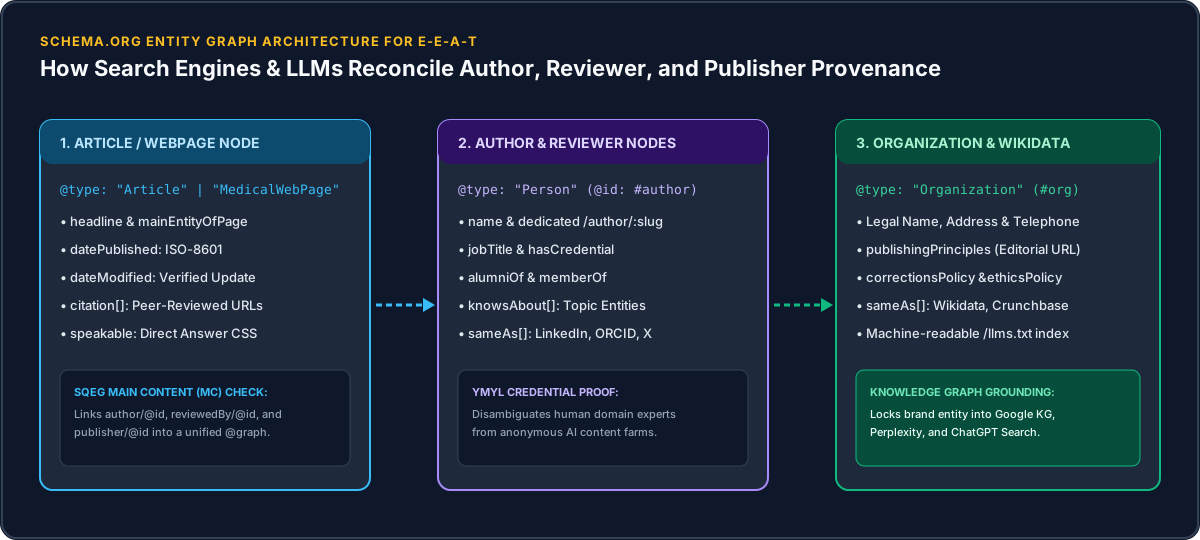
Large Language Models suffer from entity hallucination when two brands, products, or methodologies share similar names. An LLM SEO audit inspects your JSON-LD structured data to confirm that your Organization, SoftwareApplication, Service, and Person entities are linked via persistent @id URIs and disambiguated using sameAs arrays pointing to Wikidata, Wikipedia, LinkedIn, Crunchbase, and G2.
| Audit Signal | Legacy SEO Crawler Check | AI & LLM SEO Audit Check (AI SEO Auditor) | Impact on LLM Citation Rate |
|---|---|---|---|
| Crawler Directives | Checks only Googlebot & Bingbot |
Audits OAI-SearchBot, GPTBot, PerplexityBot, ClaudeBot & /llms.txt |
Critical (Binary Gate) — Blocked bots = 0% real-time RAG citations |
| Paragraph Structure | Checks total word count & Flesch reading ease | Validates 40–60 word Inverted Pyramid capsules & pronoun anaphora | +42% Extraction Lift in Google AI Overviews & Perplexity |
| Information Gain | Counts target keyword repetitions (TF-IDF) | Measures quantitative fact density (numbers, %, units per 250 words) | +38% Reranker Priority in cross-encoder scoring |
| Structured Data | Checks basic rich snippet eligibility | Validates connected @graph, sameAs Wikidata nodes & Speakable |
+31% Entity Confidence in ChatGPT & Gemini synthesis |
| E-E-A-T Provenance | Rarely audited deterministically | 9-Point Google SQEG Page Quality, author/reviewer credentials & timestamps | Mandatory for YMYL (Healthcare, Finance, Legal, B2B SaaS) |
Pillar 4: Empirical Fact Density & Citation Provenance
In landmark generative retrieval research (including the Princeton/Georgia Tech GEO study), adding quantitative statistics, verifiable benchmarks, and authoritative citations increased source visibility in generative engine responses by over 30% to 40%. During an AI LLM SEO audit, our GEO Diagnostic Engine scans every 250-word block of your content for numerical density, sample sizes, dates, and primary outbound references.
Pillar 5: Root /llms.txt Manifest & Sitemap Synchronization
Just as /sitemap.xml guides traditional crawlers, the /llms.txt specification provides LLM inference agents with a curated, token-efficient Markdown map of your canonical documentation, pricing matrices, and primary entity definitions.
Step-by-Step: How to Execute a Site-Wide AI LLM SEO Audit
- Run a Baseline Money-Page Diagnostic: Test your homepage and top 5 commercial landing pages in the AI SEO Auditor to get your baseline 0–100 AI Search Readiness Score across all 24 deterministic signals.
- Execute a 100-to-300 URL Batch XML Sitemap Crawl: Load your domain's
/sitemap.xmlinto the Batch & XML Sitemap Audit Runner to identify templates with low AEO answer capsule coverage, missingFAQPageschema, or weak E-E-A-T timestamps. - Simulate Multi-LLM Prompt Extraction: Use the AI SERP Simulator to test how ChatGPT Search, Perplexity, and Google AI Overviews synthesize answers for your highest-CPC commercial queries.
- Deploy Automated Remediation Code: Copy the generated JSON-LD
@graph,/llms.txtmanifest, and 40–60 word AEO capsules directly into your CMS and schedule weekly automated re-audits via Scheduled Audits.
Frequently Asked Questions About AI & LLM SEO Audits
How often should a business run an AI LLM SEO audit?
You should run a full batch LLM SEO audit monthly—and audit individual cornerstone pages immediately before and after publishing—because LLM retrieval indexes (such as Perplexity Sonar and ChatGPT Search) re-evaluate freshness (dateModified) and passage structure continuously.
Can I white-label AI LLM SEO audits for my agency clients?
Yes. Digital agencies using the AI SEO White-Label Platform can run 300-URL batch LLM audits, generate branded PDF executive reports, share live custom-branded client links, and export 5-slide retainer proposals via the SEO Proposal Generator.