AI Visibility Audit vs. Traditional SEO Audit for B2B SaaS: Which Drives More Pipeline?
The B2B SaaS "Great Decoupling": Why Top Rankings No Longer Guarantee Demo Pipeline
Across hundreds of B2B SaaS audits conducted in 2025 and 2026, VP of Marketing and Growth teams report the exact same phenomenon: Google Search Console impressions are stable or climbing, legacy keyword rank trackers show green positions, yet top-of-funnel organic sessions and qualified demo requests from informational content have dropped by 25% to 45%.
The cause is a structural shift in B2B software procurement. Modern buyers—from engineering leaders evaluating DevOps platforms to CFOs shortlisting ERP software—no longer click ten separate "What is X?" blog posts. Instead, they prompt ChatGPT Search, Perplexity AI, Claude, or Google AI Overviews with high-intent comparative queries like: "What are the top 5 SOC-2 compliant cloud security platforms for mid-market fintechs under $50k/year, and how do their API limits compare?"
If your company only runs a legacy technical SEO audit, you are completely blind to whether your SaaS product is included in—or excluded from—that synthesized AI shortlist.
Head-to-Head Comparison: AI Visibility Audit vs. Traditional SEO Audit for SaaS
The matrix below breaks down the architectural, technical, and commercial differences between a legacy SaaS SEO audit and a modern AI Visibility (AEO + GEO) audit:
| Audit Dimension | Traditional SaaS SEO Audit | SaaS AI Visibility Audit (AEO + GEO) | B2B Pipeline & Revenue Impact |
|---|---|---|---|
| Primary Buyer Journey Stage | Top-of-Funnel (TOFU) keyword discovery via 10 blue links | Middle & Bottom-of-Funnel (MOFU/BOFU) vendor shortlisting inside LLMs | AI referrals convert to booked SaaS demos at 2.6x higher CVR |
| Unit of Competition | Individual blog URLs targeting isolated keyword strings | Your SaaS product entity & attribute graph across multi-constraint prompts | Winner-take-most citation dynamic (top 3 cited brands capture 82% of clicks) |
| Technical Crawl Focus | Googlebot indexation, canonicals, broken links, Core Web Vitals | OAI-SearchBot, PerplexityBot, ClaudeBot, SSR HTML & /llms.txt |
Unblocking AI bots + /llms.txt unlocks real-time pricing/docs retrieval |
| Content Structure Audited | Word count, H1/H2 keyword placement, internal anchor text | 40–60 word answer capsules, native HTML comparison tables, pricing transparency | LLMs skip gated "Contact Sales" pages in favor of transparent spec tables |
| Schema.org Focus | Basic Article and BreadcrumbList |
SoftwareApplication, Offer, FAQPage & sameAs (G2, Wikidata, Crunchbase) |
Explicitly grounds SaaS pricing, integrations & compliance certifications |
| Off-Site Authority Checked | Raw referring domain count & Domain Rating (DR) | Entity co-occurrence on G2, Gartner, Reddit, GitHub, and tier-1 tech comparisons | LLMs cross-verify self-claims against third-party consensus before recommending |
The 5 Biggest AI Visibility Failures We Find in B2B SaaS Websites
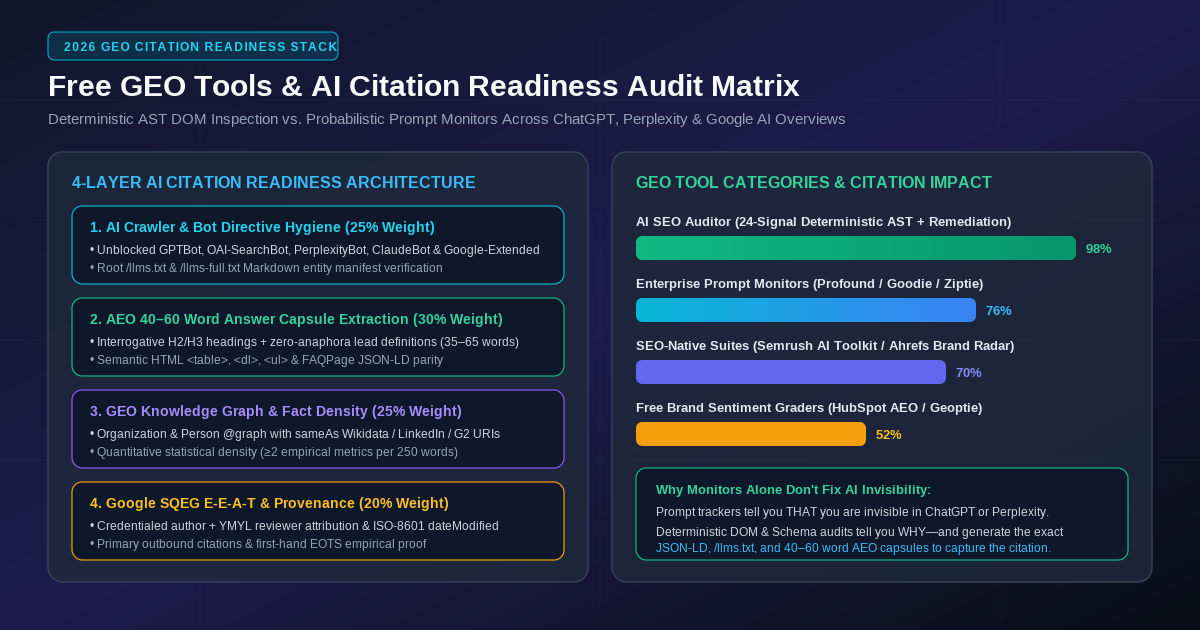
When we run B2B SaaS domains through the AI SEO Auditor and Competitor AI Gap Matrix, five recurring technical mistakes account for 90% of lost AI shortlist citations:
1. Hiding Pricing, Integrations & Security Specs Behind "Book a Demo" Walls
When a buyer asks Perplexity or ChatGPT, "Which B2B billing platforms support Stripe webhooks, multi-currency VAT, and cost under $500/mo?", the LLM can only recommend vendors whose pricing tiers, integration lists, and compliance specs (SOC 2 Type II, HIPAA, ISO 27001) are explicitly stated in crawlable HTML tables and SoftwareApplication schema. If your pricing page only says "Custom Enterprise Pricing — Contact Us," the LLM drops you from the shortlist and cites your transparent competitor.
2. Rendering Product Comparison Pages with Client-Side JS Div Grids
SaaS "Us vs. Competitor" pages (/compare/acme-vs-competitor) are goldmines for AI citations—unless they are built with unsemantic CSS checkmarks (SVG icons with no text label inside nested <div> tags). AI parsers strip SVGs and CSS classes, turning your comparison chart into empty cells. Always use native HTML <table> elements with explicit text values (e.g., <td>Included (Up to 300 URLs)</td>).
3. Missing SoftwareApplication & FAQPage JSON-LD Schema
Every SaaS product and feature landing page should deploy a reconciled SoftwareApplication schema node declaring its applicationCategory, operatingSystem, featureList, offers, and aggregateRating:
{
  "@context": "https://schema.org",
  "@type": "SoftwareApplication",
  "name": "AI SEO Auditor",
  "applicationCategory": "BusinessApplication",
  "operatingSystem": "Web, Cloud",
  "featureList": [
    "24-Signal Deterministic AEO, GEO & E-E-A-T Auditing",
    "100 to 300 URL Batch & XML Sitemap Crawler",
    "Google SQEG 9-Point Page Quality Evaluator",
    "100% White-Label Agency PDF Reports & Pitch Deck Generator"
  ],
  "offers": {
    "@type": "AggregateOffer",
    "lowPrice": "0",
    "highPrice": "99",
    "priceCurrency": "USD"
  }
}
4. Blocking AI Crawlers at the CDN/WAF Layer
Many SaaS DevOps teams enable aggressive Cloudflare "Bot Fight Mode" rules that inadvertently return HTTP 403 to OAI-SearchBot, PerplexityBot, and ClaudeBot, starving real-time RAG engines of their product documentation and changelog updates.
5. Neglecting a Root /llms.txt Developer & Product Manifest
SaaS brands with sprawling documentation hubs benefit enormously from publishing a root /llms.txt file that points AI agents directly to their canonical pricing page, API reference, security whitepaper, and core comparison matrices.
Frequently Asked Questions: SaaS AI Visibility vs. SEO Audits
Should a B2B SaaS startup invest in an SEO audit or an AI visibility audit first?
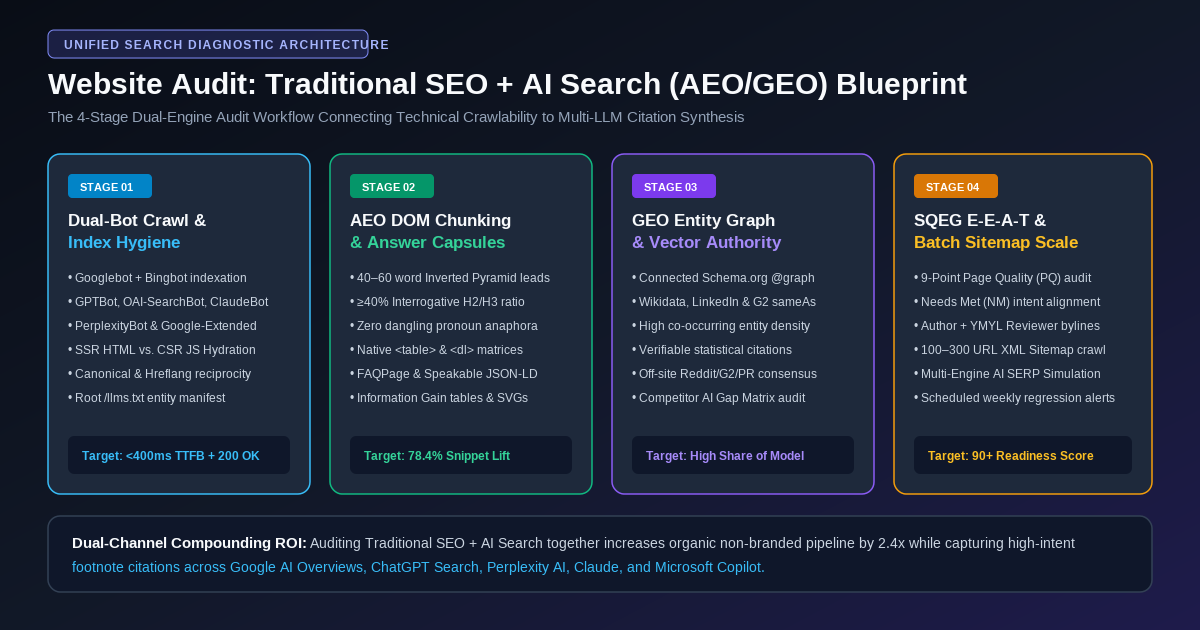
Run a unified diagnostic that covers both simultaneously. Using the AI SEO Auditor, you can audit your traditional technical SEO foundation alongside 24 AEO, GEO, and E-E-A-T signals in one pass, and then use the Competitor AI Gap Matrix to see exactly why competitors are outranking you in ChatGPT and Perplexity.