Decoding Google's 170-Page SQEG: An E-E-A-T Checklist for Modern Marketers
How Google's 170-Page SQEG Trains Core Ranking & AI Grounding Systems
Every time a Google Core Update or Spam Update rolls out, thousands of marketers speculate about mysterious ranking factors. Yet Google publicly documents its definition of web quality in its 170-page handbook: the Search Quality Evaluator Guidelines (SQEG).
Verify author schema, entity provenance, and page quality using our Free E-E-A-T Checker and Search Quality Evaluation Audit.
While an individual human rater cannot manually demote a live website in real time, the millions of structured Page Quality (PQ) and Needs Met (NM) evaluations submitted by Google's global rater workforce serve as the supervised ground-truth training data for Google's deep-learning ranking classifiers (RankBrain, Helpful Content classifiers, and Gemini AI Overview grounding filters).
In the generative search era, SQEG compliance has become doubly critical: Retrieval-Augmented Generation (RAG) pipelines apply strict E-E-A-T trust thresholds before quoting any domain inside Google AI Overviews, Perplexity AI, or ChatGPT Search, especially on Your Money or Your Life (YMYL) topics.
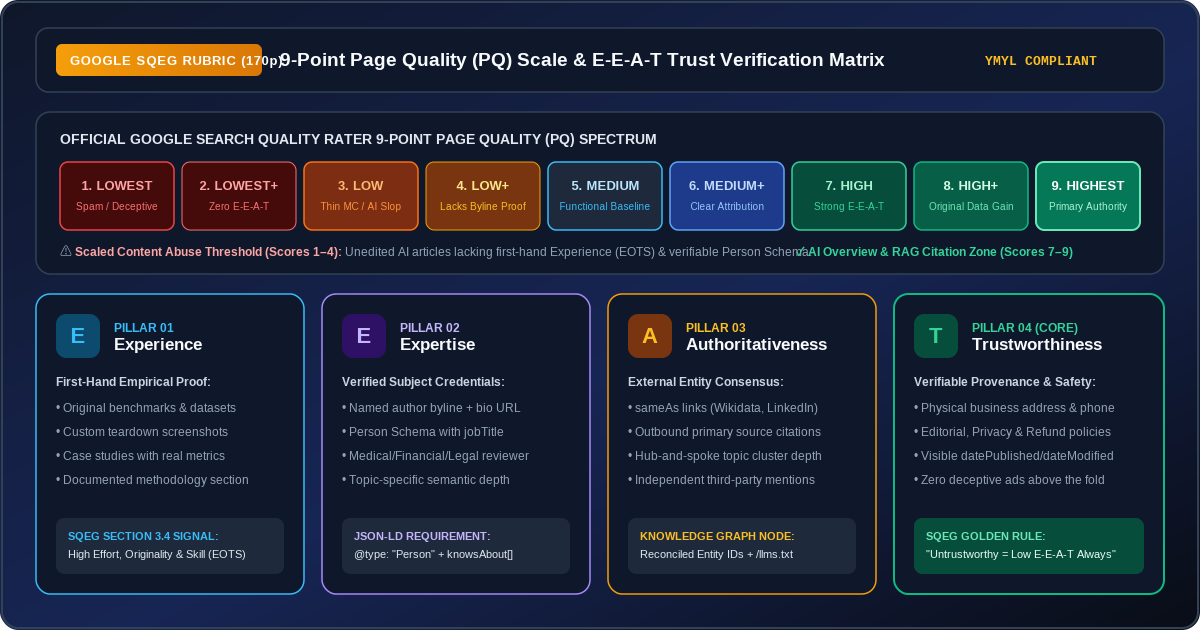
The 9-Point Page Quality (PQ) Rating Scale Deconstructed
When a Quality Rater evaluates a URL, they first partition the DOM into three structural zones: Main Content (MC) (the primary text, tools, tables, or media that achieve the page's purpose), Supplementary Content (SC) (internal navigation, related calculators, table of contents), and Ads / Monetization. They then assign a score on the 9-point Page Quality scale:
| PQ Rating Tier | Effort, Originality, Talent & Skill (EOTS) | E-E-A-T & Attribution Standard | Algorithmic & AI Overview Impact |
|---|---|---|---|
| 1. Lowest | Zero human effort; malicious, deceptive, scraped, or automated spam (Scaled Content Abuse). | Anonymous or fabricated personas; deceptive business identity; harmful YMYL claims. | Eligible for manual action, de-indexing, and total exclusion from AI citations. |
| 2. Lowest+ | Extremely thin paraphrased content created solely to manipulate search keywords or ad clicks. | Zero author credentials; intrusive interstitials obscuring Main Content. | Severely demoted by Helpful Content & SpamBrain classifiers. |
| 3. Low | Generic, unedited AI-generated summaries with zero Information Gain or original insight. | Lacks appropriate expertise for topic; missing editorial transparency or contact proof. | Filtered out during RAG cross-encoder reranking; chronic ranking decay. |
| 4. Low+ | Superficial compilation of known facts; adequate formatting but lacks depth or empirical data. | Generic "Admin" or "Editorial Team" byline on topics requiring practitioner experience. | Struggles to break Page 2; never selected as a primary AI Overview source. |
| 5. Medium | Functional, accurate Main Content that satisfies basic intent without standout originality. | Identifiable publisher; basic "About" page, but limited external authority consensus. | Ranks for low-competition long-tail queries; vulnerable to authoritative competitors. |
| 6. Medium+ | Well-structured content with clear explanations, helpful Supplementary Content, and clean UX. | Named author byline with bio and basic Article / Organization schema. |
Competitive in non-YMYL verticals; occasional secondary AI citation. |
| 7. High | Clear demonstration of human effort, custom visuals/tables, and practical practitioner insights. | Strong E-E-A-T; verified author bio page, Person schema, and cited primary sources. |
Core winner in traditional SERPs and frequent Google AI Overview citation source. |
| 8. High+ | Substantial original research, proprietary frameworks, interactive tools, or case studies. | Expert author + credentialed reviewer (for YMYL) reconciled via sameAs entity graphs. |
Dominates competitive commercial & YMYL SERPs; primary RAG ground-truth node. |
| 9. Highest | Exceptional, industry-defining original data, peer-reviewed depth, or canonical interactive tooling. | Unquestioned category authority; cited across independent tier-1 publications & Wikidata. | Maximum organic visibility and #1 default citation across ChatGPT, Perplexity & Gemini. |
The 5-Tier "Needs Met" (NM) Query Intent Rubric
Page Quality (PQ) is context-independent—it measures how trustworthy and well-crafted a page is for its stated purpose. Alongside PQ, Google raters score Needs Met (NM), which measures how completely and immediately the page satisfies the specific user query on a mobile viewport:
Deconstructing the 4 Pillars of E-E-A-T & YMYL Thresholds
In Section 3.4 of the SQEG, Google emphasizes that Trust is the center of the E-E-A-T hub, supported by Experience, Expertise, and Authoritativeness. On YMYL (Your Money or Your Life) pages—topics impacting health, financial stability, legal rights, civic safety, or major commercial investments—Google enforces strict verification thresholds:
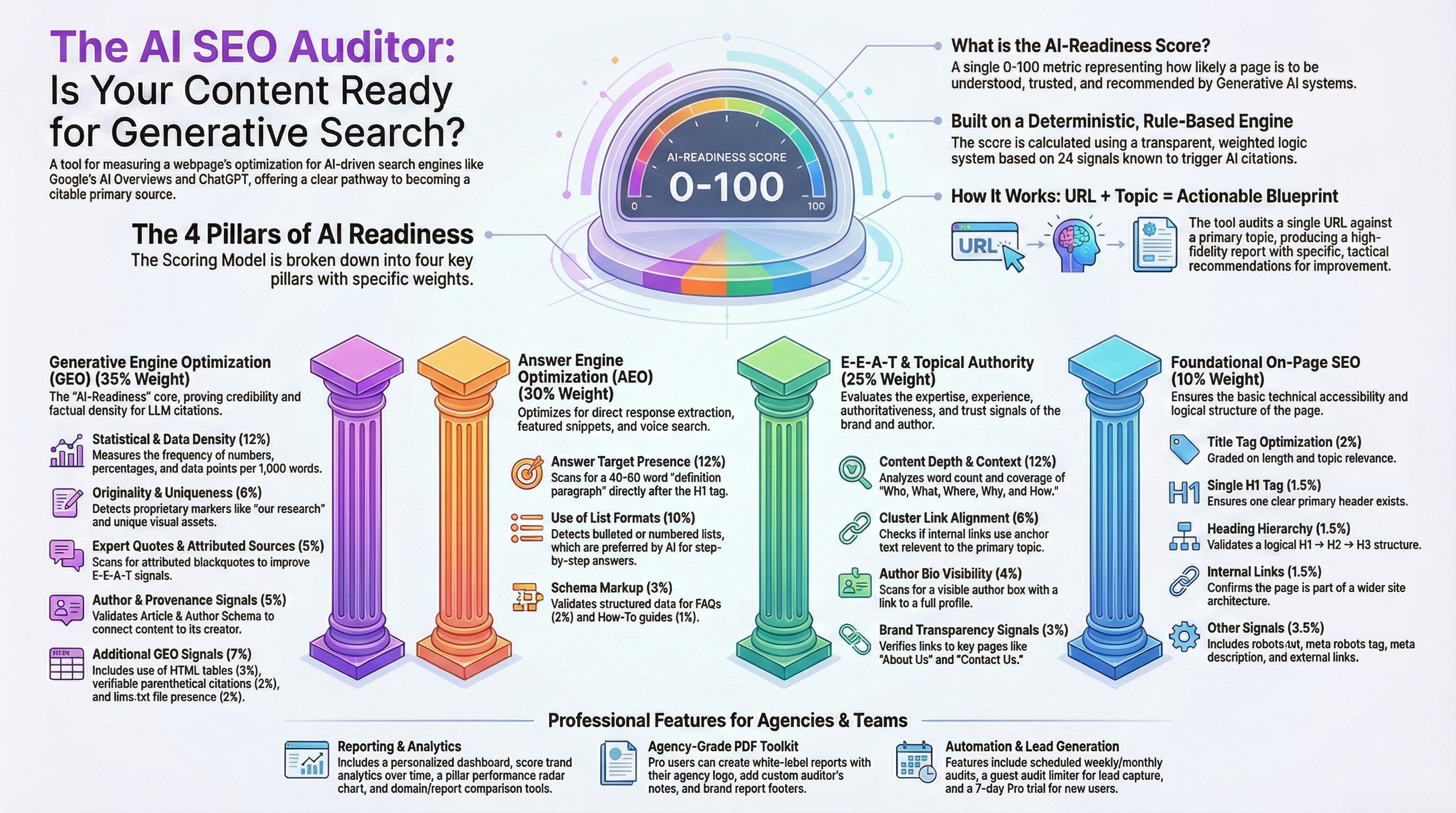
1. Experience (First-Hand Empirical Proof & EOTS)
Added to counter the flood of generic AI-written summaries, Experience asks: "Did the creator actually test this software, run this clinical protocol, or execute this agency campaign first-hand?" Raters look for signals of Effort, Originality, Talent, and Skill (EOTS): original benchmark datasets, custom architectural diagrams, real workflow screenshots, reproducible methodology sections, and nuanced edge-case analysis that an LLM could never hallucinate without real-world execution.
2. Expertise (Formal Credentials & Subject-Matter Mastery)
Expertise evaluates whether the author (and, for YMYL content, the technical or medical reviewer) possesses verified credentials, degrees, certifications, or documented multi-year career history in the field. Anonymous articles or posts attributed to "Staff Writer" automatically fail Expertise checks on YMYL queries.
3. Authoritativeness (Entity Consensus & Knowledge Graph Grounding)
Authoritativeness measures whether external institutions, industry peers, and knowledge graphs recognize your domain and authors as go-to references. At a technical level, this is reinforced by comprehensive topical cluster coverage, outbound citations to peer-reviewed or primary sources, and reconciled sameAs links connecting your site to Wikidata, LinkedIn, Crunchbase, and professional registries.
4. Trustworthiness (The Non-Negotiable Foundation)
As the SQEG states verbatim: "Untrustworthy pages have low E-E-A-T no matter how experienced, expert, or authoritative they may seem." Technical Trust signals include HTTPS security, a verifiable physical business address and telephone number, transparent pricing/refund policies, published editorial and fact-checking guidelines, visible datePublished and dateModified timestamps, and clear separation between editorial Main Content and sponsored placements.
Technical Implementation: Building a Reconciled E-E-A-T Schema.org @graph
Search engines and LLMs do not infer E-E-A-T solely from unstructured prose—they parse your Schema.org JSON-LD entity graph to verify who wrote the page, who reviewed it, who published it, and where those entities are verified across the web.
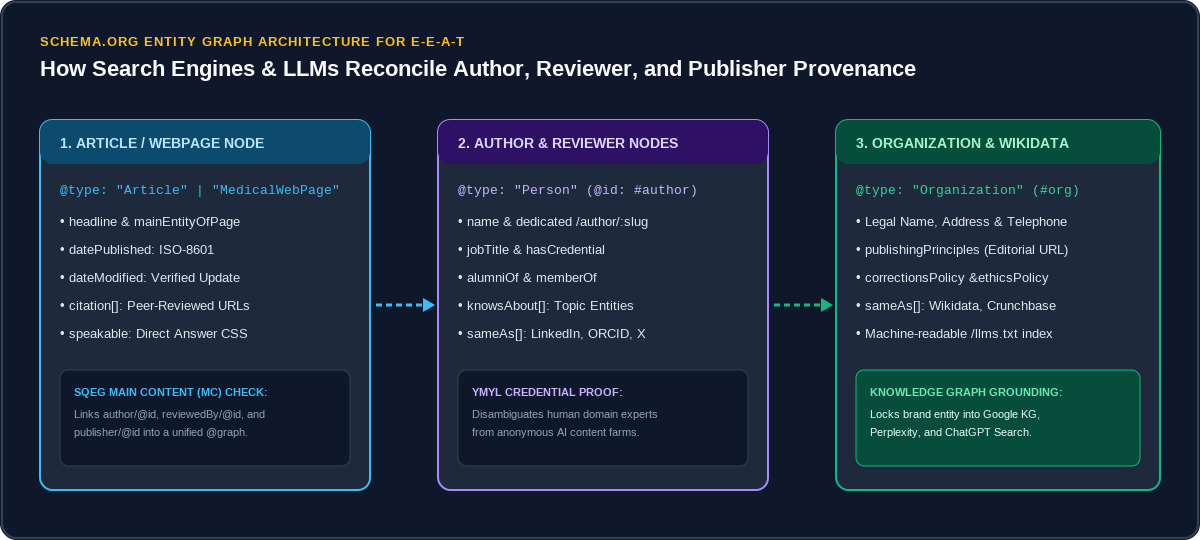
Use the following production-ready JSON-LD template to link your Article, Person (Author & Reviewer), and Organization nodes via persistent @id URIs:
{
  "@context": "https://schema.org",
  "@graph": [
    {
      "@type": "Organization",
      "@id": "https://seogrow.co/#organization",
      "name": "SEO Grow SH.P.K.",
      "url": "https://seogrow.co",
      "logo": {
        "@type": "ImageObject",
        "url": "https://seogrow.co/wp-content/uploads/2023/11/cropped-seo-grow-cropped.webp"
      },
      "publishingPrinciples": "https://ai-audit.seogrow.co/about#editorial-policy",
      "correctionsPolicy": "https://ai-audit.seogrow.co/about#corrections-policy",
      "contactPoint": {
        "@type": "ContactPoint",
        "contactType": "customer support",
        "url": "https://ai-audit.seogrow.co/contact"
      },
      "sameAs": [
        "https://www.linkedin.com/company/seo-grow",
        "https://ai-audit.seogrow.co"
      ]
    },
    {
      "@type": "Person",
      "@id": "https://ai-audit.seogrow.co/blog/author/burim-bekteshi#person",
      "name": "Burim Bekteshi",
      "jobTitle": "Founder & Head of AI SEO Architecture",
      "url": "https://ai-audit.seogrow.co/blog/author/burim-bekteshi",
      "worksFor": { "@id": "https://seogrow.co/#organization" },
      "knowsAbout": [
        "Generative Engine Optimization (GEO)",
        "Answer Engine Optimization (AEO)",
        "Google Search Quality Evaluator Guidelines (SQEG)",
        "Schema.org Entity Graphs"
      ],
      "sameAs": [
        "https://www.linkedin.com/in/burimbekteshi/",
        "https://seogrow.co"
      ]
    },
    {
      "@type": "Article",
      "@id": "https://ai-audit.seogrow.co/blog/decoding-googles-sqeg-eeat-checklist#article",
      "headline": "Decoding Google's 170-Page SQEG: An E-E-A-T Checklist for Modern Marketers",
      "datePublished": "2026-03-12T14:15:00Z",
      "dateModified": "2026-11-03T12:00:00Z",
      "author": { "@id": "https://ai-audit.seogrow.co/blog/author/burim-bekteshi#person" },
      "reviewedBy": { "@id": "https://ai-audit.seogrow.co/blog/author/burim-bekteshi#person" },
      "publisher": { "@id": "https://seogrow.co/#organization" },
      "mainEntityOfPage": "https://ai-audit.seogrow.co/blog/decoding-googles-sqeg-eeat-checklist"
    }
  ]
}
How to Prevent "Scaled Content Abuse" Demotions (SQEG Section 4.6)
In recent revisions of the SQEG, Google replaced "Automatically Generated Content" spam rules with a stricter policy: Scaled Content Abuse. Crucially, Google does not penalize AI assistance per se; it penalizes producing pages at scale without adding original human value, empirical verification, or first-hand EOTS.
To inoculate your domain against Scaled Content Abuse classifiers:
15-Point Technical E-E-A-T & SQEG Audit Checklist
Use this 15-point checklist—or run an automated scan in our Search Quality Evaluator (Google QRG & E-E-A-T Engine) and Free E-E-A-T Checker—to verify every cornerstone URL:
Frequently Asked Questions About Google's SQEG & E-E-A-T
Is E-E-A-T a direct mathematical ranking score in Google's algorithm?
E-E-A-T is not a single standalone numeric score like classic PageRank; rather, it is an umbrella evaluation framework codified in the SQEG that Google translates into dozens of measurable algorithmic signals—including entity graph reconciliation (Person and Organization schema), domain-level citation authority, author-topic co-occurrence, and helpful content classifiers.
Can AI-assisted content achieve a High or Highest Page Quality (PQ) rating under the SQEG?
Yes, provided it demonstrates clear human Effort, Originality, Talent, and Skill (EOTS), undergoes expert human editing and fact-checking, includes original insights or visual data (Information Gain), and carries transparent human author attribution. Unedited, mass-produced AI text with no original data is rated Low or Lowest under Scaled Content Abuse rules.
How can I test my page's 9-point Page Quality (PQ) and Needs Met (NM) rating?
Launch our Search Quality Evaluator (Google QRG & E-E-A-T Audit Tool) to run a deterministic diagnostic across Page Quality (PQ), Needs Met (NM), Main Content vs. Supplementary Content, EOTS, and YMYL trust signals in under 30 seconds.