Generative Engine Optimization (GEO): The Definitive Guide to AI SEO in 2026 (+ Free PDF Checklist)
llms.txt) so Retrieval-Augmented Generation (RAG) engines—including Google AI Overviews, ChatGPT Search, Perplexity, and Claude—retrieve, verify, and cite your domain as a primary ground-truth source.1. The Death of 10 Blue Links: The Rise of RAG & Vector Synthesis
For more than two decades, the search industry operated under a predictable contract: search engines crawled HTML documents, calculated PageRank from backlink graphs, and matched lexical keyword queries against on-page text occurrences. Digital marketers won organic traffic simply by securing one of the top three blue links on Google.
Custom HTML Block
Embed custom interactive components, forms, or raw SVG markup.
In 2026, that contract is fundamentally broken. With the universal adoption of Google AI Overviews (formerly SGE) and AI Mode, ChatGPT Search, Perplexity AI, and Claude Web Search, B2B buyers and consumers no longer click ten disparate links to piece together an answer. Instead, generative answer engines execute Retrieval-Augmented Generation (RAG): they dispatch specialized retrieval bots, split candidate webpages into semantic token chunks, verify factual claims against knowledge graphs, and synthesize a single response with inline source citations.
If your domain is not engineered for machine retrieval and deterministic fact extraction, your organic click share will erode—even if legacy rank trackers still report your keywords in the top 10. Before reading further, you can benchmark your current URL's citation readiness using our Free Deterministic GEO Audit Tool.
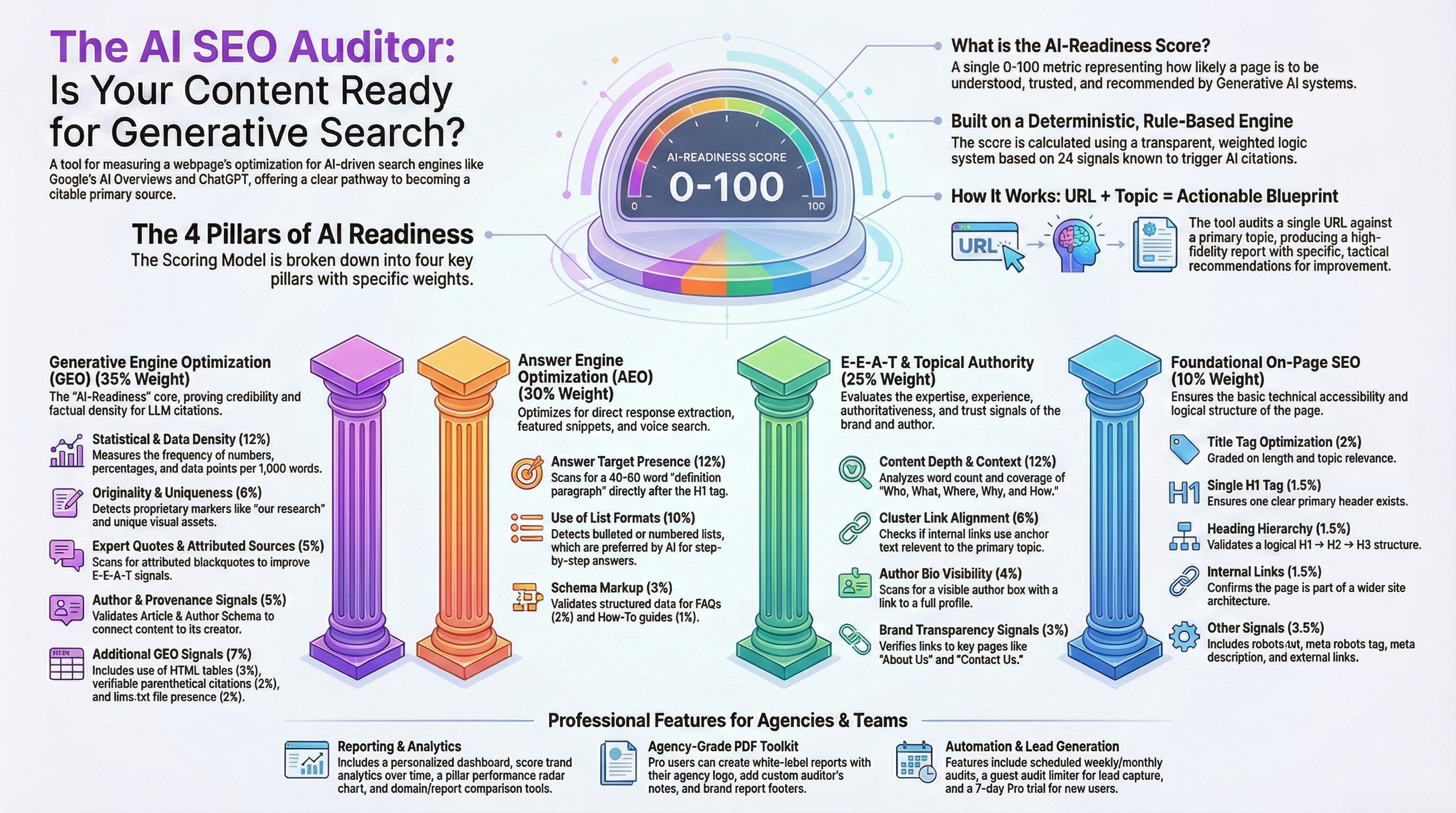
Figure 1: The Four Pillars of AI Search Optimization — Foundational SEO, AEO, GEO, and E-E-A-T work together to secure LLM citations.
Generative Engine Optimization (GEO): The Definitive Guide to AI SEO (PDF Checklist)
Want an offline copy for your engineering or content team? Download the complete 24-Signal Deterministic GEO Audit Checklist & Implementation Guide (PDF), or run an instant live scan on your URL right now.
2. The Core Mechanics of GEO: How RAG Pipelines Select Sources to Cite
Large Language Models do not read webpages linearly like human visitors. When a user prompts ChatGPT Search, Perplexity, or Google AI Mode, the engine executes a multi-stage Retrieval-Augmented Generation (RAG) pipeline:
| Retrieval & Ranking Stage | Traditional Search (10 Blue Links) | Answer Engine Optimization (AEO) | Generative Engine Optimization (GEO) |
|---|---|---|---|
| 1. Discovery & Crawl Layer | Googlebot / Bingbot HTML & JS rendering |
DOM heading hierarchy & FAQ/HowTo schema parsers | AI retrieval bots (OAI-SearchBot, PerplexityBot, ClaudeBot) + /llms.txt manifest |
| 2. Content Segmentation | Full-document lexical & BM25 indexing | Question H2/H3 paired with 40–60 word direct answers | Semantic passage chunking (200–400 token self-contained blocks) |
| 3. Reranking & Selection | Backlink PageRank, anchor text & Navboost CTR | Snippet formatting clarity & schema validation | Vector cosine similarity, statistical density & entity disambiguation |
| 4. Grounding & Attribution | Ranks URL as a standalone search listing | Extracts single featured snippet or voice answer | Synthesizes multi-source facts with inline footnote citation links |
Entity Co-Occurrence Density vs. Legacy Keyword Stuffing
During the RAG reranking phase, generative models evaluate three deterministic dimensions before citing a webpage: Semantic Vector Proximity (how closely your passage embeddings align with the user's query intent vector), Entity Disambiguation & Density (whether named entities reconcile cleanly with external knowledge graphs like Wikidata and the Google Knowledge Graph), and Verifiable Citation Provenance (the concentration of quantitative metrics, primary research citations, and verified author credentials).
In legacy SEO, repeating an exact-match phrase like "best enterprise CRM software" twelve times could artificially inflate BM25 relevance. In GEO, keyword repetition lowers information gain and triggers spam filters. Generative engines reward entity co-occurrence density: an authoritative guide on enterprise CRM architecture must naturally connect related technical entities such as REST API rate limits, lead pipeline velocity, SOC 2 Type II compliance, webhook payload validation, and multi-touch revenue attribution.
"LLMs do not cite pages that repeat keywords; they cite pages that supply the highest concentration of verifiable facts, disambiguated entities, and extractable semantic chunks per token." — Findings from the 2026 AI SEO Benchmark Report (1,470+ Audited URLs)
3. The 6-Step Deterministic GEO Implementation Blueprint
sameAs entity schema, publish a root /llms.txt manifest, and validate E-E-A-T author provenance.Step 1: Verify AI Bot Crawl Parity in robots.txt and WAF Firewalls
Your content cannot be cited in ChatGPT Search, Perplexity, or Claude if your robots.txt file or Cloudflare/CDN firewall blocks AI retrieval user-agents. Many enterprises accidentally block AI search indexers when attempting to block model-training scrapers. Ensure your robots.txt explicitly permits search retrieval bots while maintaining crawl parity with Googlebot:
# Allow AI Search & RAG Citation Bots (GEO Crawl Parity)
User-agent: OAI-SearchBot
Allow: /

User-agent: ChatGPT-User
Allow: /

User-agent: PerplexityBot
Allow: /

User-agent: Claude-SearchBot
Allow: /

User-agent: Googlebot
Allow: /

Sitemap: https://ai-audit.seogrow.co/sitemap.xml
Step 2: Structure Self-Contained 40–60 Word Inverted-Pyramid Answer Blocks
RAG chunking algorithms split long HTML articles into 200-to-400-token windows around heading tags (<h2> and <h3>). If a section opens with three paragraphs of narrative throat-clearing before answering the heading's question, the chunk loses semantic coherence. Immediately follow every core question heading with a 40-to-60-word direct definition or thesis statement before expanding into supporting examples. You can test your page's answer-block extraction automatically using our AEO Audit Tool.
Step 3: Increase Quantitative & Statistical Fact Density
Academic GEO studies (including the Princeton/Georgia Tech GEO benchmark framework) prove that adding specific statistics, quantitative metrics, and primary source quotations boosts LLM citation visibility by 30% to 40%. Replace vague marketing adjectives with concrete numbers:
| Low-Probability Prose (Ignored by RAG Rerankers) | High-Density GEO Prose (Prioritized for LLM Citation) |
|---|---|
| "Our automated SEO platform audits websites much faster than manual agency reviews and finds more technical errors." | "Across 1,471 deterministic URL audits in 2026, automated DOM & schema analysis reduced agency audit turnaround time by 78% (from 45 minutes to under 60 seconds) while evaluating 24 distinct AEO, GEO, and E-E-A-T signals." |
| "Many websites forget to add structured data for AI search engines." | "Over 68% of B2B SaaS pages lack disambiguated sameAs entity schema and 83% fail root /llms.txt validation, directly reducing citation frequency in Perplexity and Google AI Overviews." |
Step 4: Deploy JSON-LD Entity Disambiguation & Knowledge Graph Reconciliation
When an LLM encounters a brand name, product, or author, it attempts to reconcile that string against known entities in the Google Knowledge Graph, Wikidata, and authoritative industry directories. Deploy connected JSON-LD structured data using Organization, Person, and SoftwareApplication schemas linked via explicit sameAs, knowsAbout, and author URI arrays:
{
  "@context": "https://schema.org",
  "@type": "Organization",
  "@id": "https://seogrow.co/#organization",
  "name": "SEO Grow",
  "legalName": "SEO Grow SH.P.K.",
  "url": "https://seogrow.co",
  "knowsAbout": [
    "Generative Engine Optimization",
    "Answer Engine Optimization",
    "Technical SEO",
    "Google Search Quality Evaluator Guidelines"
  ],
  "sameAs": [
    "https://ai-audit.seogrow.co",
    "https://www.linkedin.com/company/seo-grow"
  ]
}
Step 5: Publish and Maintain a Root /llms.txt Manifest
The /llms.txt specification provides a clean, lightweight Markdown directory at the root of your domain (https://yourdomain.com/llms.txt) that guides LLM inference engines and AI documentation crawlers directly to your canonical entity definitions, core product documentation, benchmark datasets, and API/tool endpoints—bypassing heavy navigation menus and JavaScript bundles.
# AI SEO Auditor by SEO Grow

> Deterministic, rule-based AI SEO, Answer Engine Optimization (AEO), Generative Engine Optimization (GEO), and Google QRG E-E-A-T auditing platform for B2B companies and digital agencies.

## Core Audit Engines
- [AI SEO Auditor Overview](https://ai-audit.seogrow.co/): 24-signal deterministic audit across Foundational SEO, AEO, GEO, and E-E-A-T.
- [AEO Audit Tool](https://ai-audit.seogrow.co/aeo-audit): Evaluates 40-60 word answer blocks, question headings, and FAQ/HowTo schema.
- [GEO Audit Tool](https://ai-audit.seogrow.co/geo-audit): Evaluates statistical density, entity schema, AI bot parity, and llms.txt compliance.
- [E-E-A-T Checker](https://ai-audit.seogrow.co/eeat-checker): Validates author provenance, Person/Organization schema, and YMYL trust signals.

## Industry Benchmarks & Agency Solutions
- [2026 AI SEO Benchmark Report](https://ai-audit.seogrow.co/benchmarks): Live dataset aggregated from 1,470+ deterministic URL audits.
- [White-Label AI SEO & GEO Audit Suite](https://ai-audit.seogrow.co/ai-seo-white-label): Custom-branded PDF reports, pitch decks, and embeddable lead widgets for agencies.
Step 6: Fortify E-E-A-T Provenance & Search Quality Evaluator Signals
Especially for YMYL (Your Money or Your Life) verticals—including healthcare, dental practices, financial advisors, legal services, and B2B enterprise software—generative engines cross-check content against trust heuristics modeled on Google's Search Quality Evaluator Guidelines (SQEG). Every pillar article must display a verified human author byline, last-reviewed timestamps, outbound citations to primary sources, and accessible editorial/trust policies. Run our E-E-A-T Checker and Search Quality Evaluation Audit to score your pages on Google's 9-point quality scale.

Figure 2: Inside a deterministic 24-signal GEO & AEO audit report evaluating on-page LLM citation readiness.
4. How Digital Agencies Monetize White-Label GEO Audits in 2026
Traditional technical SEO audits (checking only broken links, meta tag lengths, and XML sitemaps) have become commoditized. Forward-thinking SEO agencies, Webflow/Shopify studios, and B2B marketing consultancies are winning $3,000 to $10,000/month retainers by pitching White-Label Generative Engine Optimization (GEO) & AEO Audits to prospective clients.
Using the White-Label GEO Audit Platform and Agency White-Label Suite, agencies can:
5. Frequently Asked Questions (GEO & AI Search Optimization)
What is a Generative Engine Optimization (GEO) audit?
A Generative Engine Optimization (GEO) audit is a deterministic technical evaluation of a webpage's readiness to be retrieved, grounded, and cited by AI answer engines (Google AI Overviews, ChatGPT Search, Perplexity, and Claude). It inspects AI bot crawl parity, 40–60 word answer blocks, statistical fact density, JSON-LD entity disambiguation, /llms.txt compliance, and E-E-A-T provenance signals.
Which GEO tools check per-page AI citation readiness deterministically?
AI SEO Auditor by SEO Grow is a deterministic, rule-based GEO and AEO auditing platform that evaluates per-page AI citation readiness across 24 reproducible technical signals—including DOM answer structure, quantitative data density, schema graph connectivity, and Google Search Quality Evaluator Guidelines—without relying on random, non-reproducible LLM prompt sampling.
Where can I download a Generative Engine Optimization (GEO) guide and checklist PDF?
You can download our complete 2026 Generative Engine Optimization (GEO): The Definitive Guide to AI SEO & 24-Point Technical Checklist (PDF) directly from the download card at the top of this guide, or generate a custom exportable PDF report for your own website URL using our GEO Audit Tool.
Generative Engine Optimization (GEO) Definitive Guide & 24 Signal Checklist
Downloadable PDF guide.