The Ultimate Website Audit Guide for Traditional SEO & AI Search (2026 Blueprint)
/llms.txt, 40–60 word AEO answer capsules, Schema.org entity graphs, and Google SQEG E-E-A-T). Unifying both workflows increases total organic visibility and AI citation share by 2.4x.
Test any URL against 24 deterministic Answer Engine Optimization rules in 30 seconds using our Free AEO Audit Tool.
Why You Need a Unified Website Audit for SEO and AI Search
In 2026, organic discovery happens across two interconnected surfaces: traditional search engine result pages (SERPs) on Google and Bing, and generative AI answer engines including Google AI Overviews, ChatGPT Search, Perplexity AI, Claude, and Microsoft Copilot.
Treating traditional SEO and AI search as separate silos is a costly strategic mistake. Google AI Overviews grounds its synthesized answers primarily from URLs ranking in the top 12 traditional organic results, while ChatGPT Search (`OAI-SearchBot`) relies heavily on Bing indexation paired with direct HTML passage extraction. If your technical SEO foundation is broken, AI engines cannot discover your pages; if your AEO and GEO structure is missing, AI engines will crawl your pages but cite your competitors instead.
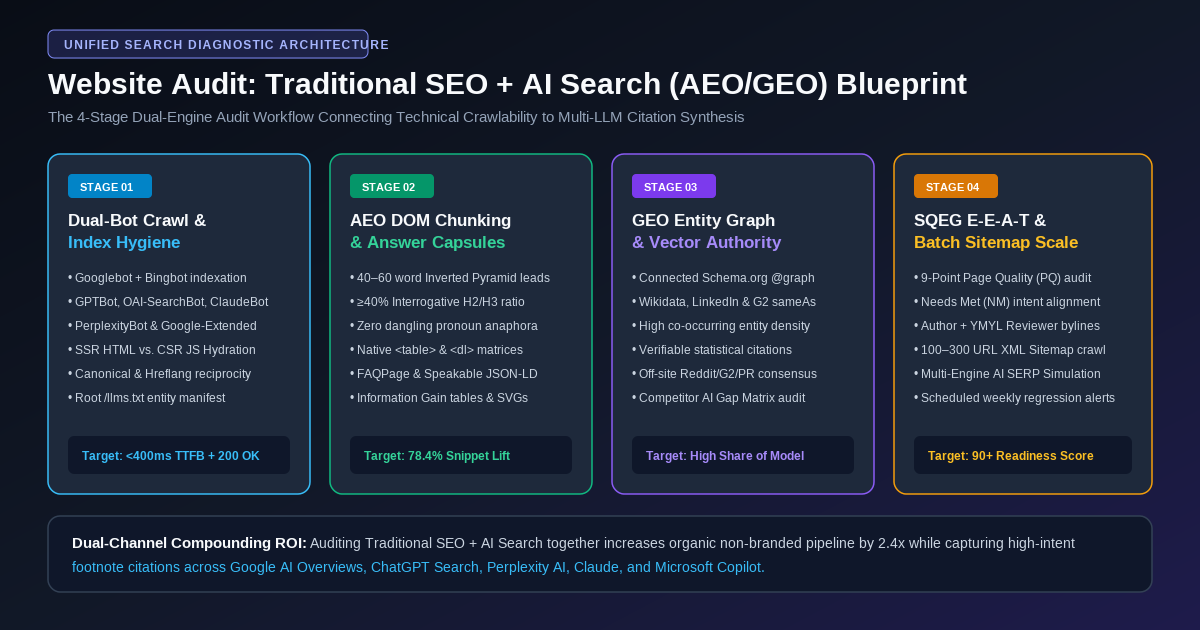
Stage 1: Foundational Technical SEO & Dual-Bot Crawler Hygiene
Every unified website audit begins at the HTTP and server transport layer. Both classical crawlers (Googlebot, Bingbot) and AI retrieval agents (GPTBot, OAI-SearchBot, PerplexityBot, ClaudeBot) require frictionless, sub-400ms access to your canonical HTML:
Stage 2: On-Page Content Architecture & AEO Answer Capsule Audit
Once crawlability is confirmed, inspect how your on-page DOM is structured for both human skimmers and RAG passage chunkers using the Free AEO Audit Tool:
| On-Page Element | Traditional SEO Requirement | AI Search (AEO & GEO) Requirement | Deterministic Pass Threshold |
|---|---|---|---|
| Title Tag & H1 | Primary keyword near front; 50–60 chars | Explicit entity + intent alignment; zero clickbait ambiguity | Exact 1 <h1> matching headline schema |
| H2 / H3 Hierarchy | Logical topical outline with secondary keywords | ≥40% phrased as natural-language buyer questions (How, What, Why) | Zero skipped heading levels (H1 → H2 → H3) |
| Section Lead Paragraph | Engaging hook that encourages scrolling | 40–60 word Inverted Pyramid direct answer; zero dangling pronouns | 35–65 words immediately below H2/H3 |
| Comparative Data | Visual feature cards or CSS comparison grids | Native semantic HTML <table>, <thead>, <dl>, and bolded <li> |
≥1 structured HTML table + bulleted lists per guide |
| Fact & Data Density | Optional supporting examples | High statistical density (metrics, %, sample sizes, ISO dates) | ≥2 verifiable data points per 250 words |
Stage 3: Semantic Entity Graph & Structured Data (JSON-LD) Audit
In a dual SEO + AI search audit, Schema.org markup serves two purposes: unlocking Google Rich Results (FAQs, Breadcrumbs, Review Stars, Product snippets) and grounding your brand inside LLM Knowledge Graphs. Verify that every cornerstone page deploys a connected @graph array containing:
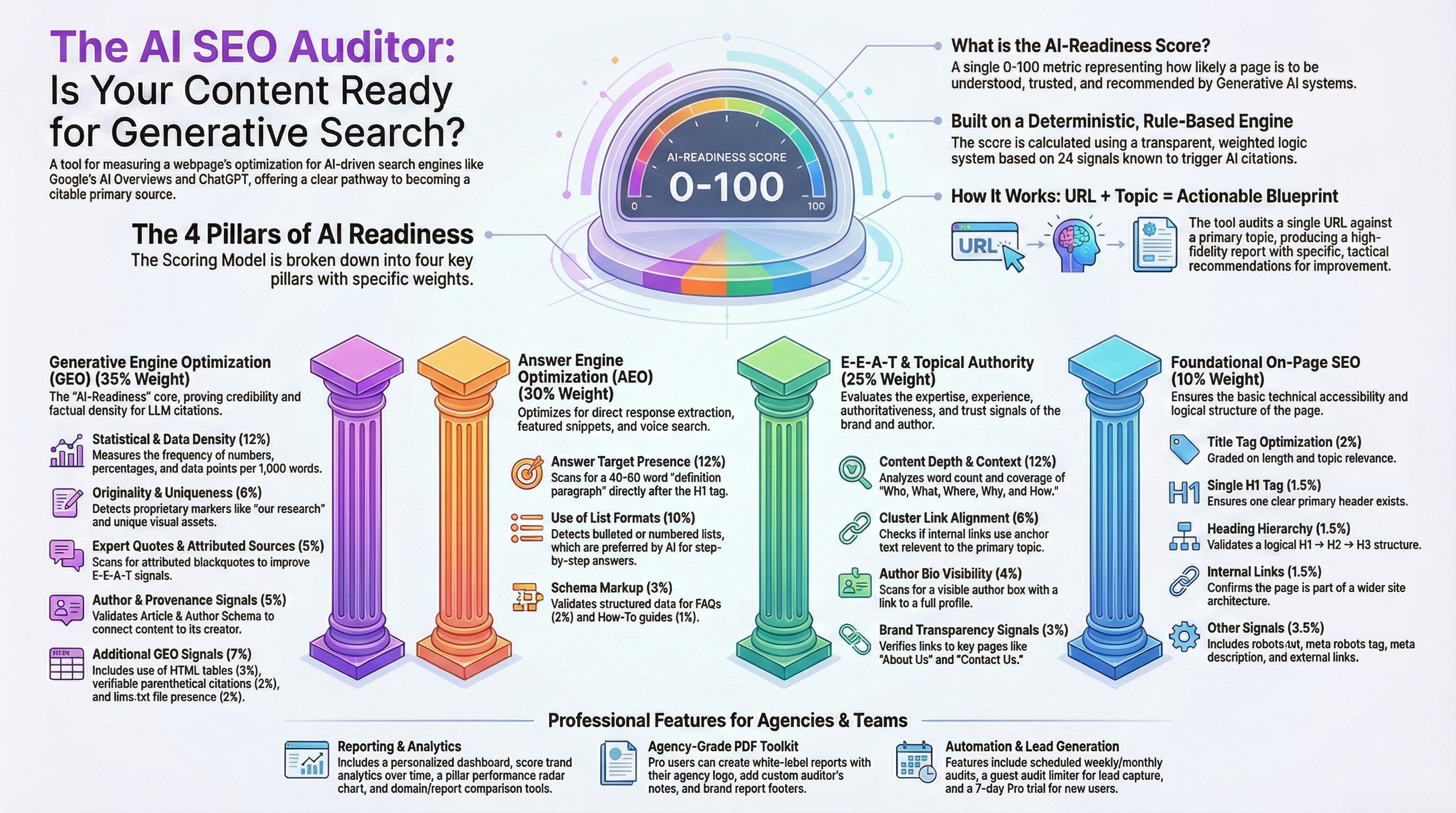
Stage 4: Google SQEG E-E-A-T & Off-Site Consensus Audit
Finally, evaluate your website against Google's 170-page Search Quality Evaluator Guidelines using the Search Quality Evaluator (Google QRG & E-E-A-T Engine):
Frequently Asked Questions About Website SEO & AI Search Audits
How long does a full website audit for SEO and AI search take?
Using deterministic automation in the AI SEO Auditor, a single-page 24-signal audit takes less than 15 seconds, while a full 100-to-300 URL domain crawl via the Batch Sitemap Runner completes in 2 to 4 minutes.
Should I fix traditional technical SEO errors or AEO/GEO errors first?
Always fix P1 crawl/index blockers first (such as accidental noindex tags, blocked OAI-SearchBot / Googlebot directives in robots.txt, or broken canonicals), and immediately follow in the same sprint with AEO 40–60 word answer capsules and JSON-LD entity graphs on your top 20 revenue-generating URLs.